Showing posts with label Wine Industry. Show all posts

Thursday, December 12, 2013

How three wineries use Instagram to grow their brand + 5 useful tips

As I write this, it seems like the popular social network is ripe for exploitation by wineries, and other markets as well. Many brands have yet to focus on Instagram as a viable option for social media marketing, despite reports that “Based on median increases in subscriber growth, user engagement and sales effectiveness, Instagram has been crowned the best-performing social platform of 2013, according to analytics firm SumAll.” It is, after all, the fastest growing social network of the year. Each day its 150 million users upload 40 million photos.


The instant sharing nature of Instagram makes it a popular choice for brands that want to showcase their business, products, and lifestyle connections. In the wine industry, many brands are slow to adopt social networks, and that’s certainly the case here. But there are a few that have been making solid headway, and using the platform to grow their brand.


Red Cap Vineyards


Followers: 807

#redcapvineyards: 414

Total posts: 97

Red Cap Vineyards is young winery, born on the hillsides of Howell Mountain alongside other big names like Dunn, Outpost, and Robert Craig. In 1998, the owners purchased 10.5 acres of property in Angwin and planted the first vines in 2003. They craft an amazing Cabernet Sauvignon, the first vintage of which was released in 2006, and a Sauvignon Blanc as well. Out of all the wineries I’ve looked at, they seem to have the biggest correlation between their presence on Instagram and the growth of their brand.


As a new brand with no marketing budget, they joined Instagram in February 2013 and quickly amassed a devout following of fans. They networked with fellow wine enthusiasts, influential users, and owners of wine bars across the country to spread the word about their brand and it seems to have paid off. To date, they have more than 800 followers and 400+ photos with the hash tag “redcapvineyards” have been shared. Not a bad show after only nine months on the social network.


Jordan Winery


Followers: 1329

#jordanwinery: 433

Total posts: 625

No surprise to see Jordan as the top of the list of most active wineries on Instagram. They’re a hip, fun winery known for being on top of their game when it comes to social media and online marketing. Earlier this year they created a parody music video for Robin Thicke’s “Blurred Lines” song, which got huge amounts of shares and has 32k views so far. What I find interesting is that while they have a huge amount of followers, relatively speaking, there are only about 400 photos tagged “#jordanwinery”. I notice they don’t always comment on or share photos that others post using the #jordanwinery hashtag, which seems like an obvious opportunity to increase engagement and gain more followers.


Whitehall Lane


Followers: 498

#whitehalllane: 212

Total photos: 103


Whitehall Lane has a strong presence on social media, and their efforts were recently highlighted in great article on Social Media Examiner. They joined Instagram late in 2012, and have started to grow a solid foundation of followers and shares. They take a slightly different approach than other wineries that use the social network, posting a lot more humorous photos meant to create brand loyalty and awareness. Of course, they still promote their wine with crisp bottle shots and images from around the vineyard and tasting room. Taking a cue from the tips below, Whitehall Lane even partners with other brands like GoVino, to promote sponsored contests. They’re also very good at cross-pollinating their social media accounts by sharing across networks, retweeting others’ content, and liking photos from similar brands around wine country with audiences that align with their own.


5 ways brands can use Instragram


1. Create, use, and monitor hashtags

If you post lots of pictures of wine on Instagram, then you probably use typical hashtags like #wine #napavalley or #cabernet for example. But creating your own can be much more useful because it gives you an easy way to search for and track images that use your hashtag, especially from fans and followers. To give you an example, the tag #dirtybands and #thewinepoor have both gained huge usage among “true” wine connoisseurs who routinely share pictures of their Ridge Monte Bello, Colgin, and other small production favorites.


2. Sponsor contests
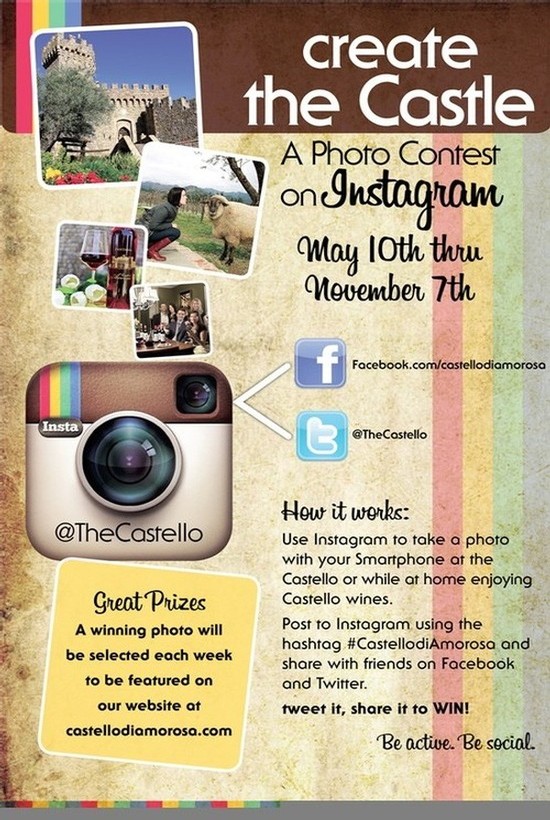
2013_Instagram_PSTR

When Castello di Amorosa ran their “Create the Castle” contest, they asked for fans to post a picture of the castle or their wines, along with the hashtag “#castellodiamorosa”. So far there have been more than 9,000 pictures shared with that tag. Think about the exposure that generates for a brand, when nine thousand people actively share and promote their product. The only reward they offer was the chance for your photo to be shared on their website, so the cost to run a contest like this was next to nothing.


3. Bring authenticity to your brand

Sharing photos makes for a great way to showcase different sides of your brand and business. For wineries, this might mean taking a picture of the sun rising over a misty vineyard, or the freshly harvested grapes flowing out of a bin and into a destemmer, showcasing bottle shots, and visitors who enjoy their time at the winery. Be sure to tag those visitors and encourage them to share. Beyond the winery itself, it means sharing behind the scenes pictures of the family dinner, the vacation to Breckenridge, and a dinner at RN74 in San Francisco. Connect with people based on the lifestyle that’s associated with your brand.


4. Connect with Facebook and other networks

Use the “find friends” features that come with Instagram to connect with existing fans on Facebook and other social networks. Send an email announcement to your mailing list and encourage them to join you on the network, possibly even to participate in a contest to gain some extra momentum. Use a website or service like Statigr.am or Web.stagram to search for relevant hashtags and browse followers online, which makes it really easy to follow new users and like photos. The more users you follow and photos you like, the more fans will reciprocate the favor.


5. Discover and partner with influential users

I don’t see many wine brands doing this, but it’s a common trend among larger brands using Instagram. For example, Paypal hosted a series where each week they would invite a prominent figure from some lifestyle or market to be a “guest Instagrammer” who shares their adventures in a certain context. What you need to realize is that while a winery might consider 500-1000 followers a pretty good number, there are users out there with 500k+ avid fans. Check out @alice_gao who shares her passion with 500k+ followers and you’ll see what I mean. Use a service like Nitrogram to find influential users, measure their reach, and monitor your audience growth. Another hint – if you find a user who seems influential in your vertical, scan the list of people who follow them to find more fans who might align with your brand. Do the same for the people who your influencer follows, and you’ll discover the people they admire.


There’s still plenty of room for early adopters on this social network. With the recent advent of Instagram advertising, it will be interesting to watch how brands take advantage of the platform in 2014.


The post How three wineries use Instagram to grow their brand + 5 useful tips appeared first on Mike Meisner.


Wednesday, March 13, 2013

The future of online wine sales [Infographic]


A while back I posted a decent infographic showing the state of consumer direct wine sales, and how the industry has grown over recent years. Using data from a variety of sources, including Silicon Valley Bank, I pulled together some relevant pieces of information to show how the industry is growing in various ways. Stay tuned for the updated, and much better version!


Grab the code (small)


<img src=”http://www.mikemeisner.com/wp-content/uploads/2012/04/direct_to_consumer-319×1024.png” alt=”direct to consumer infographic for wine” />


Embed code (full size)


<img src=”http://www.mikemeisner.com/wp-content/uploads/2012/04/direct_to_consumer.png” alt=”consumer direct wine sales infographic” />


The post The future of online wine sales [Infographic] appeared first on Direct to Consumer Wine Marketing - Blue Dog Solutions.


Friday, January 4, 2013

Sink or Swim: Marketing Wine in 2013

New, “inbound marketing” strategies are more effective, cost less, and generate measurable results.


If your wine business relies on traditional PR methods to gain traction, you’re in for a harsh reality check moving forward in 2013. Gone are the days where copywriters and executives huddle together to craft the perfect message, and then broadcast it from the rooftops and attract hoards of interested customers.


As Bill Lee of the Harvard Business Journal points out in his article, “Marketing is Dead,”


“First, buyers are no longer paying much attention. Several studies have confirmed that in the “buyer’s decision journey,” traditional marketing communications just aren’t relevant. Buyers are checking out product and service information in their own way, often through the Internet, and often from sources outside the firm such as word-of-mouth or customer reviews.”


Are you attracting enough visitors to your website to convert leads?

Are you attracting enough visitors to your website to convert leads?


The old model where customers learn about your product from television ads, magazines, radio and press releases is deprecated. Consumers wield the power to decide what they’re exposed to; they fast-forward through commercials, listen to streaming radio, and signup for do not call lists. They read consumer reviews, share their interests on social networks, and look to other peer experts for advice. They do not wait for your PR agency and executives to tell them what to think. They value privacy, and do not want overt


Power up social media


It’s up to companies to cultivate their brand image from the ground up by fostering brand-advocates and interacting with their customers directly Social-Media-Marketing through social media. Here are some tools that might help you:


  • Followerwonk – Find targeted Twitter users by keyword, location, and sort by their influence/reach.

  • Topsy – This powerful tool searches various social/blogging/web channels for keywords you enter. Use it to find current conversations about your brand, similar products, or even competitors.

  • Quora – A great place to find collective “thought leaders” for any number of topics. Users ask questions, and the answers are cultivated and scored based on their helpfulness.

  • Twitter lists – Do you segment your followers? You should. Create lists for certain customers, bloggers, or other groups in your social circles. Google+ has a similar feature as well. For example, create a list for wine bloggers, and another for influential local residents, and one for your wine club members.

  • Twitter search – Use Hootsuite to set up a monitor for a particular term. If you’re goal is to attract more tasting room visits, you could track things like “napa winery recommendation” or “Visiting Napa” – then reach out to any users who mention an upcoming trip to Napa.


Wrestle your data to win


You can gain a ton of insight into your customers with the right data - but sorting through it all can be challending.

You can gain a ton of insight into your customers with the right data – but sorting through it all can be challending.


In 2012 there was a lot of buzz surrounding “big data” and for good reason. It helped our President win an election, but without the right tools and help, it can be difficult to sort through the massive piles of information we have at our fingertips. But the insights are there, and you can find what you need to further your lead nurturing process if you look in the right places.


In 2013, understanding your business data will be more important than ever. One of the biggest complaints that C-level executives have about tratitional marketing firms is the lack of accountability and measurement. With today’s tools, we can learn way more and make better judgement calls about marketing campaigns and their effectiveness. Traditional marketing firms blow a lot of “brand equity” smoke, but this sort of talk has less substance than ever.


Leads from inbound marketing cost on average 61% less ($135 vs. $346) than outbound marketing leads. (Earnest Agency)


Identify goals and track performance


Begin by asking the right questions. Understanding your business goals is paramount to success, and can help pin down the best performance indicators to track. You are measuring things like newsletter signups, add-to-cart clicks, cart abandonment, and landing page conversion rates right? Do you know the value of your branded vs. non-branded keywords to your bottom line? What about the per visit value of your latest email marketing campaign? Or what cities you’re attracting highest converting visitors from? You may even venture into multi-attribution modeling, which is becoming more important than ever in understanding how sales channels interact and assist each other.


79% of marketers measure website traffic from social media, and 68% track engagement metrics on social networks, but just 26% measure the relationship of social media activity to leads and sales. (Marketing Charts)


More content results in growth, leads


It’s been said before, and I’ll repeat it again: content is king. Every brand should focus on creating quality content to share on their website, blog, and with other outlets. It’s not enough to have a five page website, with a simple “About us” page. People want details. They want to read about specific, personal things like how you came up with a label name or design, or what a particular vineyard brings to the wine.


More content = more leads. On average, companies “with 51-100 web pages generate 48% more traffic than companies with 1-50 pages.” What’s interesting though is the differential is larges for very small companies (those with less than 10 employees), likely because larger companies make greater use of lead gen tactics like tradeshows, webinars and video. (Polaris B)


It’s not easy to create compelling content that engages your audience. But you can’t win if you don’t start somewhere. If you don’t have time to write, hire someone to help. There are plenty of options for copywriting, blogging, and infographic creation. Once you get a solid amount of content connected with your brand, new inroads open and you can attract traffic for new keywords. Today’s SEO methods rely heavily on content creation, and a small website with little copy simply won’t rank well in search engines.


49% of B2C marketers rank SEO tops for impact on lead generation, followed by pay per click (26%) and social media (25%). (Marketing Charts)


Bridge the web and real world gap


You don’t need to hide behind the computer screen in order to build your following. In fact, one of the best things to do is get out into the real world and share your wine with people. But here’s a tip – skip the pour events. Instead, head to Meetup.com and look for local wine tasting groups. The San Francisco Bay area has tons of them, with some numbering in the thousands. Bring a few bottles of your wine and some business cards to an event. Which do you think will bring you closer to new consumers – being one out of a hundred other labels at the next Ft. Mason event, or a more intimate one-on-one interaction with a smaller, tighter knit social group?


While you’re at it, spend some time getting closer with your wine club members. They are your existing brand ambassadors, and wield powerful influence. Come up with creative ways to entice them to share your brand with friends, and reward them for their loyalty.

Consumers are increasingly skeptical of advertising, and while 76% of marketers believe “they know what their consumers want” in terms of social media content and interaction, only 34% have actually asked those buyers. So get out there and start asking them!


At least on the B2C side, there is a disconnect between what marketers think consumers think is important and what consumers actually value. Marketers believe the highest consumer priorities on social media are insights for buying decisions (59%) and customer service (58%). Consumers actually place the highest value on deals and promotions (83%) and rewards programs (70%). (e-strategy trends)


Traditional marketing may not be completely dead, but it’s certainly on life support. Take the time to cultivate your social presence, and build your peer network of brand supporters. Do not lump them into one group; instead, offer incentives and rewards to segments, and create more targeted offers. The rising tide of social influence will lift your brand equity much more than a press release or Wine Spectator advertisement will.